
Hazardous waste management provider Wastecare Group, have successful trialed a mechanised vape recycling process at their Halifax battery recycling plant.
In this week’s budget announcement (Weds 6th March 2024), the Government confirmed they plan to ban disposable vapes in in England, in line with Scotland and Wales. This has now been confirmed in a published draft of new legislation, which is set to come into place in April 2025. In addition to this, the Government have also announced that they plan to levy duty on the nicotine extract from October 2026. These incentives we hope will incentivise HMRC, Border Force and the police, to better regulate and ultimately reduce the grey import of vapes.
What is in no doubt is that the popularity of vapes is likely to continue to increase in 2025, with an ever-increasing number being discarded into general waste. To tackle this issue, all vape retailers are now required to offer free disposal. While, public buildings, hospitality venues and other commercial premises are providing dedicated vape bins. This means a huge increase in safe disposal routes becoming available to most users. Despite this, we are still relying on a cultural change in public vape disposal habits.
Wastecare was the first recycler to roll out a national collection network for anyone wanting to provide their customers, employees, and visitors a safe disposal option. Having rolled out over 8,000 free collection points over the past year, we are collecting vapes from many retailers and DCFs, while we do not export vapes or send them to another company for treatment.
Early into this initiative, the challenge that presented itself was to develop a safe, efficient, and cost-effective recycling and recovery solution.

Wastecare Trials Mechanised Vape Recycling
The EA have banned the burning of post-consumer vapes; however, they have not as yet approved a mechanical treatment process. Instead, they continue to push hand-dismantling – arguably not a practical, cost effective nor an intrinsically safe solution. At the same time the EA promote high temperature incineration of pre-consumer vapes. We provide this service both for unwanted and confiscated stock at our HTI facility in Kent.
With this in mind, we are very pleased to confirm that we have now achieved a safe, efficient, and cost-effective mechanised vape recycling and recovery solution for post-consumer vapes.
We have been running trials on an adaptation of our battery recycling plant to perform a mechanical treatment process. With several treatment lines for different waste streams including portable batteries, we have a track record in creating and operating mechanical and mixed manual/mechanical systems.
Furthermore, we have in-house treatment facilities for the downstream outputs of the process, with a high temperature incinerator dealing with the nicotine contaminated elements, and our channels with lithium battery recyclers to safely treat resulting batteries. For the process to be cost effective, we need build sufficient feedstock which we are currently building.
We believe this process fulfills the necessary environmental criteria: 70% + recovery, no discharge of nicotine to atmosphere, and no risk of fire.
Our Chairman Peter Hunt has said of the development:
“We are confident we will get approval on our new plant, although we expect, as will all environmental permits this will take time to processed and be awarded. In the meantime, we have a plan.”
Pending treatment, the vapes are stored at our licensed, permitted facilities. To encourage safe disposal of these devices, Wastecare are willing to subsidise the collection of vapes until such time Defra amend the regulations to encompass vapes and the EA award a permit for a viable plant in the UK.
“The race is on but no matter who is first to get approval to safely treat vapes, society, as a whole, should hopefully be the winner.” – Peter Hunt
For more information on our vape takeback schemes or WEEE producer compliance, please contact the team at compliance@wastecare.co.uk
For any enquiries regarding our vape recycling trials, please contact recycling@wastecare.co.uk.
Get in Touch
Contact our friendly team of experts to arrange a collection or just enquire about our services.
Call us today on 0800 091 0000
or email us on recycling@wastecare.co.uk
Under the Waste Electrical and Electronic Equipment (WEEE) Regulations in the UK, vape retailers will no longer be a part of the Distributor Takeback Scheme. Instead, all retailers selling vapes are obligated to provide customers with a service for the proper disposal of their vapes and e-cigs. Retailers must offer a vape takeback scheme from 1st April 2024.
Retailers will be required to takeback vapes that offer the same function as those they sell in store – which is determined by functionality not brand. The return of vapes is on a ‘one for one’ basis, however this must be a free of charge service.
To set up a recycling service retailers must have an appropriate collection point in-store, and partner with an authorised waste management provider to ensure the safe disposal and recycling of the collected vapes. We would encourage retailers to enquire with their vape supplier(s) to establish if they have a vape collection scheme already in place.
Failure to adhere to these regulations not only exposes retailers to potential legal repercussions, but also continues to contribute to the environmental degradation caused by vapes thrown into general waste.
Wastecare Vape Takeback
Wastecare have currently rolled out 8,000 vape collection bins nationwide, and this number continues to grow. We have designed four battery collection containers to accommodate retailer floor or counter space requirements, capable of safely collecting a large volume of vapes. These are available to purchase by both individual retailers or vape producers who wish to roll out a takeback scheme across their distributor network.
More information on vape retailer takeback requirements can be found here.
For more information on Wastecare’s vape takeback services, please get in touch with the team at sales.enquiries@wastecare.co.uk, or call 0800 091 0000.
Vape FAQs
What vapes can be collected?
Both disposable and reusable vapes can be collected. We would encourage retailers to also have a battery collection bin alongside their vape bin. This enables customers who can disassemble their vapes to dispose of the battery separately ready for recycling.
How often do vape bins need to be collected?
It is the retailer’s responsibility to organise a collection with Wastecare once their bin is nearly full. We would recommend organising scheduled collection when a store’s average collection volume has been established.
Do the vape collection bins need to contain vermiculite?
No. Vermiculite when used to mitigate the risks associated with lithium-based batteries is used as a separation material to prevent ignition upon contact with one another. Upon assessment, the same risks do not apply to vapes as the lithium battery and their terminals are enclosed.
What happens to the vapes once they are collected?
Currently, many vape recyclers are having to dismantle vapes by hand in order to retrieve the lithium battery, nicotine fluid and filters for recycling and/or recovery.
This process is resource-heavy and expensive; therefore we are currently trialing a mechanised dismantling process for vapes into order to keep our costs low and increase efficiency.
Get in Touch
Contact our friendly team of experts to arrange a collection or just enquire about our services.
Call us today on 0800 091 0000
or email us on recycling@wastecare.co.uk
It has come as no surprise to us at Wastecare, and the wider waste management and compliance sector, that the government has announced today (Monday 29th Jan) the intention to ban disposable vapes in the UK. As well as banning single-use devices, the government is expected to introduce restrictions on flavours and marketing, as well as implementing higher taxes on vape products.
We know that as with any new bill, the likelihood of this ban being enforced is likely to come with an extended timeline of enforcement. Health Secretary Victoria Atkins has been quoted saying she was “confident the new bill would pass Parliament the time of the general election [expected to be this year] – with it coming into force in early 2025”.
The driving force behind the ban lies in the concern for rising numbers of youths taking up the habit due to the ease of access and sweet flavours of these vapes. However just as prevalent has been the environmental concerns regarding improper disposal and battery-related fires. The spotlight was firmly on the need for a solution when Material Focus published its findings last year on disposable vapes, calculating that a shocking 5 million vapes are thrown away every week. Undoubtedly this figure will have risen since then.
Like many in the industry, we are interested to see how the following is addressed in the coming months:
What will classify as a ‘disposable’ vape in regard to design
If there will be extended measures put into place to manage the illegal vape market. The Guardian revealed last year that millions of illegal and harmful vapes had been seized by trading standards in the past three years, with experts warning “this was likely to be the tip of the iceberg and that a “tsunami” of products were flooding in.”
Impact on funding solutions for disposable vape recycling once it becomes an illegal market
Whilst these questions amongst many others roll on – we cannot neglect the importance of spreading awareness amongst the public on responsible vape recycling. Disposable vapes will continue to be sold and discarded as this public consultation on smoking and vaping is driven forward – therefore the waste management sector must not lose momentum in pushing out collection points and educating users.
With over 5,500 vape collection points and counting, we at Wastecare will endeavour to continue pushing forward with responsible vape recycling and provide support and guidance to retailers and producers alike.
For more information on disposable vape collection and recycling, please contact our team at sales.enquiries@wastecare.co.uk or call 0800 091 0000.
If you are a vape producer or importer into the UK and would like to know more about your producer compliance obligation, contact our compliance team: compliance@wastecare.co.uk
Get in Touch
Contact our friendly team of experts to arrange a collection or just enquire about our services.
Call us today on 0800 091 0000
or email us on recycling@wastecare.co.uk
Welcome to the February/March 2024 Issue of Wastecare’s Newsletter
This year has certainly got off to a great start. Despite the daily news of conflicts across the world, global warming, and reminders of the nation’s increasing national debt, there are encouraging signs that green shoots are taking root across the economy.
Whether your interest is producer compliance, the distributor take-back scheme, the deposit return scheme or simply keeping up with new technologies in recycling, recovery and reuse, it is good to keep up with developments and share concerns and ideas. I also hope you can join us on one of our forthcoming events detailed in this newsletter.

In this edition, we discuss:
- Our upcoming Yorkshire Tour with Jumbo the Battery Elephant and Battrecycle to raise awareness on responsible battery recycling
- A whistlestop tour of our High-Temperature Incinerator, including how it works and the energy harnessed to produced electricity as a result
- Our rollout of remote engineer waste drop-off points, and the current demand for fallen stock clearance services
- How we are facilitating the collection and recycling of disposable vapes across thousands of collection points and counting nationwide
- The long-awaited WEEE regulations reform recently published by the government
- A look at the Transfrontier Shipping Regulations, raising the issue of the UK’s dependence on shipping our waste to our neighbours
- An invitation to join our February webinars on WEEE Regulations ahead of the consultation, and how to implement a takeback scheme
And much more. We hope you enjoy this latest issue of The Sustainable Insider.
Alternatively, download our newsletter here.
For media enquiries, please contact marketing@wastecare.co.uk.
Get in Touch
Contact our friendly team of experts to arrange a collection or just enquire about our services.
Call us today on 0800 091 0000
or email us on recycling@wastecare.co.uk
Opinion piece by Matt Stoneman, Wastecare Group Sales Director
For centuries, Britain has stood as a beacon of innovation and manufacturing prowess. However, in the last fifty years, a significant portion of our engineering and manufacturing has been outsourced abroad along with many of our inventions developed overseas. Waste management and recycling has followed the same path. Despite being a critical force in safeguarding our planet, it is yet another sector who have become heavily reliant on other nations for innovation, investment, and waste recycling.
The global movement of waste has reached staggering proportions. Europe alone exports more than 30 million tonnes of waste worldwide a year while importing 16 million tonnes from outside the EU. In addition, a shocking estimate of over 8 million tonnes of additional waste is being illegally shipped worldwide.
In response to this crisis, the EU implemented the Export of Waste Regulations in November 2021 in an attempt to curb waste crime and impose controls on the volume of waste exported. In the UK, the Environment Agency governs the movement of recyclable materials across borders through the Transfrontier Shipment (TFS) Regulations. However presently, over 800,000 tonnes of waste are being legally exported annually from the UK – with plastics constituting over 60% of this trade. In our eyes, this practice of sending materials offshore that could be processed and recycled domestically is completely counter-intuitive.
We all know the UK’s trade balance with other nations has been in deficit for over four decades. This imbalance is exacerbated by paying other countries to handle our waste and subsequently paying for products manufactured from the same waste. The irony is clear.

Moreover, aside from transport costs and the environmental impact of increased carbon emissions, outsourcing waste management while continuing consumption perpetuates an economically flawed cycle. And others are catching on. China, India, Turkey, and Vietnam amongst others have started refusing our waste, and The Netherlands have implemented a waste import tax to regulate volumes entering the country. Repercussions of our waste export trade hit the headlines in early 2022, when the Environment Agency incurred a £1million bill from Indonesia to repatriate illegally exported waste—a burden borne by taxpayers whilst leaving the perpetrators unpunished.
The need for change is glaringly evident in the pursuit of global net zero waste disposal. It’s time to challenge these practices and the status quo. Why can’t we process this material domestically when we have the capacity to do so?
Countries like Germany, Switzerland, and Sweden serve as key examples of having invested in sustainable, efficient, and clean waste recovery methods internally. Sweden’s model means that it recycles nearly half of what is thrown away, and the majority of the rest is utilised in waste-to-energy processes – leaving less than one percent reaching landfill. This continued investment in recycling practices to reach the EU’s recycling target of 65% by 2035 remains at the forefront of Sweden’s strategies.
Our call is for the UK government and regulators to champion recyclers and re-processors, whilst encouraging investment in cutting-edge technology to position the UK as a leader in waste management.
However we do want to stress that advocating for self-sufficiency in waste management doesn’t oppose free trade. While importing products can be economically justified, the scenario becomes more intricate concerning waste. Refuse Derived Fuels and Solid Recovered Fuels for instance, are often transported to Sweden and Germany for recovery, incurring additional costs for transportation, treatment, and resulting in higher-priced electricity and products.
Ultimately, it’s now more imperative than ever for the UK to leverage its domestic infrastructure to attract investments that elevate our waste management standards and reduce costs for all. While benefiting from a global economy, we must strive for self-sufficiency and carbon reduction in avoidable circumstances.
Get in Touch
Contact our friendly team of experts to arrange a collection or just enquire about our services.
Call us today on 0800 091 0000
or email us on recycling@wastecare.co.uk
We are pleased to announce our latest partnership to increase vape collection and recycling across the UK. We have teamed up with e-cigarette and vaping group Supreme Plc and global vape brand ELFBAR, to roll out vape collection bins across all B&M stores.
This monumental scheme Supreme describes as the “first of its kind to appear in the entire state of a nationwide retail chain”, in the hope it will “significantly increase” the expansion of recycling.
With more than 700 in-store vape recycling bins due to be rolled out in the coming months, Wastecare will be managing the collection and recycling. We are currently trialling mechanised approaches to dismantling vapes, with the collected devices to be recovered and recycled in line with existing disposal rules: the vape batteries are processed to recover the lithium, and the filter and nicotine elements are sent for incineration.
These vape bins will provide a convenient disposal point for B&M’s shoppers, whilst our nationwide logistics network will ensure a sustainable and efficient collection process. We believe that a visible recycling scheme with consistent collections will demonstrate the commitment of vape producers and retailers alike and will be a key step toward shifting public behaviour.
If you’re a vape producer, importer, distributor or retailer – our collection and our compliance team are on hand to provide expert advice and solutions – contact them here or email recycling@wastecare.co.uk
Get in Touch
Contact our friendly team of experts to arrange a collection or just enquire about our services.
Call us today on 0800 091 0000
or email us on recycling@wastecare.co.uk

Arcus Compliance recently sat down with our Head of Compliance Clément Gaubert, and our Head of Systems Development Kyle Beachill, to discuss the recent changes to EEE regulations that are due to have an impact on vape producers and importers. Arcus’ Managing Director Robert Sidebottom asks what the PBS will mean for vape producers, why vape recycling has been a problematic process up to this point, and what course of action we believe producers should take to navigate the changes.
Rob: Kyle, can you give me a quick run-down of exactly what has changed and why?
Kyle: So right now vapes are classed as category 7 under the EEE producer compliance responsibility, which covers toys and other items which are quite cheap to collect and recycle. What that’s led to is a problem whereby a lot of local authorities and mixed recycling facilities have ended up with a lot of vapes that producer compliance schemes can’t afford to pick up under the current system. So there exists a ‘backstop’ called the Producer Compliance Scheme Balancing System (PBS), that allows local authorities to make a request to have waste electricals collected, in the situation when their usual contracted collection supplier – usually a compliance scheme – say that they’re not prepared to collect it.
Rob: So are there a number of waste collection companies refusing to collect vape products?
Kyle: It’s not so much that they’re refusing to collect them, but rather that they’re seeing very, very high costs associated with recycling them. So typically vapes are anywhere around £10,000 to £11,000 per tonne to recycle because of the manual processes involved in taking them apart.
In addition, there’s quite a high amount of contraband in the vapes, so we’re not quite sure what they’re made of, and we’ve the POPs issues around the plastics that are in them. We’ve also got lithium batteries that need recycling and we’ve got incineration – so this whole process means they’re extremely expensive to collect and recycle properly, and the current regulations and the category 7 they’re in now doesn’t cover those costs.
So we’re not necessarily seeing schemes refuse to collect them, but what we are seeing are waste companies saying we’re quite happy to collect them, but at the actual cost of recycling.
Rob: So they’ve been keeping hold of all these vapes as they have predicted this was coming?
Kyle: Yes, certainly because of the pressure that’s being placed on DEFRA by local authorities and by the public, because of the environmental concern, particularly around single-use vapes, this has been in the pipeline for 6 months. So we are expecting a backlog of single-use vapes at these sites.
Rob: So what should the vape industry be doing now with regards to this change?
Kyle: I think the important thing is to look and work as an industry to ask ‘How can we control this situation, and how can we bring this cost down?’; because what we’ll see is that as things go through the PBS is there’s absolutely no control over the cost. They will see a quarterly invoice being issued back to the compliance schemes for these costs of collection, which will be allocated back to those vape producers who have joined a compliance scheme.
What we’re then going to see is that those producers will end up paying for the recycling of all the vapes coming out of these sorts of facilities – whether that’s contraband, grey-market imports, or legitimate single-use and reusable vapes.
I think the important thing now is working out how we reduce the overall cost of compliance. And I think its mainly an education piece. So what we’re looking for is the vape industry to work as a whole to educate the public about what should they do with single-use vapes and how do they go about recycling them. If we can control that narrative, we can get people to do the right thing, and we can then work with existing waste collectors who are going to places like retailers anyway – resulting in the actual cost of collection for those vapes will likely be much lower.
Rob: So do you think that responsibility for educating the consumer lies directly with the vape industry, or should it also lie with the local authorities as well?
Kyle: I think there’s a mix. If we look at people like Material Focus, they work hard under the Recycle Your Electricals campaign to try and educate people about the right thing to do with vapes, and they work with the local authorities to get the right messaging in place. But I think fundamentally there is a responsibility on the producers to say ‘This is what you do and this is how you responsibly recycle vapes and this is what you should do with them’. And I think part of the problem is we’re seeing such a disparate message from different producers, and so many different types of recycling initiatives.
It’s quite easy for consumers to simply get confused or not think about it when they’re buying a single-use product. They’re taking it out of the packet, throwing the packet away, and unless there’s something that’s really easy that says this is what you need to do with it, and in as simple message as possible, I think it’s inevitable that people will tend to do the wrong thing.
Clément: I think as a producer you want to control your costs and you want to do the right thing. So with vapes, you’ve got an opportunity to be a leading force in the change because you could either put out containers and as Kyle mentioned control your costs and transportation and do the education piece, or you could wait and you’ll have this PBS invoice which is harder to explain and harder to understand. So we are a big advocate of transparency and compliance costs, and it’s already a tough sell for producers – as we often refer to this as a ‘tax’.
So what we’re saying with vapes, especially because of the cost involved, is that we need support to increase the number of collection points across the UK to be more productive – as with the PBS we’re going to have at least 12 months’ worth of backlog. So the more the producers do the right thing, and join a scheme, this will spread the cost across more vape producers.
Rob: So there’s a bit of a challenge here isn’t there? So what we’re trying to do, and I’m talking as an industry, we’re going to try and encourage as many people as possible to sign up for these schemes because that spreads the cost. And that is the right thing to do – I get that entirely. However if people don’t sign up for these schemes, is there much of a penalty?
Clément: Well it’s a tricky one because sadly there currently isn’t a framework for heavy penalties. Unlike packaging regulations where you can go back in time and backdate the obligation producers have accumulated several years, in the WEEE system the responsibility of the producer relies on a regulator. The regulator in this case is the EA, and from their own admission they struggle to go after the ‘free riders’.
There are also companies importing vapes from around the world, so there are a lot of layers in these importing companies. So it’s a tricky one to get the ‘bad guys’ as it were, and then the penalties are not strong enough to distract people not to join a scheme. It’s worth noting that they will be consulting on a new regulation soon, and we are expecting a new mechanism for stronger penalties for people avoiding paying for compliance schemes.
Kyle: I think the other thing to be conscious of is that vapes are such a hot topic because of the environmental concerns. As a result, we are seeing retailers pushing back and making sure that their suppliers are registered as part of a scheme. So I think as well as the actual enforcement side, there’s definitely a shift in retailers wanting to make sure their suppliers are picking up the costs as they should and are legally compliant to be able to stock the product.
Rob: You mentioned in your previous article that there’s a likely increase of up to 5000% in terms of the costs that are currently being incurred because of the category change. So we did a little calculation prior to this and we calculated that it could be anywhere between 3 to 5 pence per product, is that correct?
Kyle: Yes. If we look at what the cost of category 7 evidence is now which is around £200 – £220 a tonne, and we compare that to the actual cost of collecting and recycling vapes that might be on their own that somebody’s going to have to send out a vehicle to pick up. That could be £11,000 a tonne. So yes, between three and four pence if we assume a vape is around 40 grams.
Rob: That’s a considerable additional cost that producers now need to start taking into account. So what can people who have not signed up for a scheme do now? I’m guessing they can sign up to a scheme at Wastecare? And how do they go about that?
Clément: Yes, they can reach out to us and then it’s a simple case of registering company details, and we would ask for data, e.g. how many tonnes they place on the market either as an importer or manufacturer. So, anything they place on the market in 2023 or 2022 would need to be reported because compliance always looks at the year prior. When they join the compliance scheme, they are assigned a unique compliance number which is given by the Environment Agency, and that number will demonstrate compliance. They can then share this with suppliers, customers, and industry bodies as proof that they are a part of a scheme. They will pick up membership fees, registration fees, and that market share on the cost.
Rob: Now my last question is about the technology for recycling. Obviously, we’ve got quite a difficult item to recycle at this moment in time. It’s turning out to be quite expensive – so will this cost come down as the industry gets better at a) producing devices which are more recyclable, and b) you guys get better recycling these types of products? Is that likely to happen?
Kyle: I think there’s a couple of things there. I think the speed at which vapes have come onto the market and the rapid uptake of the product has caused problems for the recycling industry. The sheer volume of them has far outpaced the investment in recycling them.
I think we’ve also got a problem where we’ve got a rumoured ban on single-use vapes within the next 18 months or so, which is likely to cause problems because it deters investment.
Having said that, I think there’s a place for more mechanical recycling away from the hand disassembly that’s happening now – and we’ve got some trials in place. We’re working with the EA on a more mechanical-based solution that we are hoping will significantly bring down the costs.
About Arcus Compliance
Arcus Compliance Ltd specialises in helping vape brands to build their compliance strategies, to navigate the constantly evolving regulations that face the vape, cannabis/hemp, cosmetics, medical device and adult health industries.
Get in Touch
Contact our friendly team of experts to arrange a collection or just enquire about our services.
Call us today on 0800 091 0000
or email us on recycling@wastecare.co.uk
The East London Waste Authority (ELWA) has partnered with Wastecare Group to host their battery recycling campaign across four London Boroughs during 2023 Recycling Week.
The Waste Prevention Programme team at ELWA and the four Constituent Councils have been touring the boroughs of Havering, Newham, Redbridge, and Barking and Dagenham, with the colossal ‘Jumbo the Battery Elephant.’ Drawing crowds at the Liberty and Mercury Shopping Centre in Havering on its first stop of the week, Jumbo has now taken to the Stratford Shopping Centre in Newham to emphasise the scale of improper battery disposal.
Jumbo’s next stop on his tour will be the Exchange Ilford in Redbridge, followed by Dagenham Library in Barking and Dagenham. Visitors will have the opportunity to chat with the team on how and where to dispose of their batteries and small electrical appliances safely across East London, as well as drop off their used batteries next to Jumbo himself. These batteries will be responsibly collected and processed by Wastecare Group to ensure proper recycling and disposal.
Mr Matt Stoneman, Sales Director of Wastecare, expressed his enthusiasm for the campaign, stating, “We believe that by bringing Jumbo the Battery Elephant to London’s bustling shopping centres, we can make a meaningful impact in raising awareness about the importance of battery recycling. Together with ELWA, we are committed to creating a cleaner, more sustainable future for London.”
Mariam Bajulaiye, the Waste Prevention Manager at the East London Waste Authority (ELWA) highlighted that this partnership campaign across the four Constituent Councils of Barking and Dagenham, Havering, Newham and Redbridge will support residents to understand the necessary steps required to appropriately recycle batteries and disposable vapes. Residents are urged to make sure they dispose of old batteries and disposable vapes correctly, either at local shops with a battery bank or at their local recycling centre. The four reuse and recycling centres in ELWA have a dedicated battery recycling and vape recycling bank.
This unique collaboration between ELWA and Wastecare demonstrates their shared dedication to environmental responsibility and community education. For more information about ELWA’s appropriate battery recycling campaign, please visit [https://www.eastlondonwaste.gov.uk/batteries/] or contact Mariam Bajulaiye at enquiries@eastlondonwaste.gov.uk or 020 8724 5803.
About ELWA:
The East London Waste Authority (ELWA) is a statutory joint waste disposal authority, responsible for the sustainable treatment and disposal of waste collected by the London Boroughs of Barking & Dagenham, Havering, Newham and Redbridge, along with the operation of four Reuse and Recycling Centres. Approximately 450,000 tonnes of waste is delivered to ELWA by the Constituent Councils each year, collected from over 1.1 million residents.
Get in Touch
Contact our friendly team of experts to arrange a collection or just enquire about our services.
Call us today on 0800 091 0000
or email us on recycling@wastecare.co.uk
We are pleased to announce the launch of Battrecycle – a new nationwide partnership to increase battery collection volumes and recycling across the UK. Much like its predecessor BatteryBack, this will be a free service funded by battery compliance schemes including Wastecare Compliance. The campaign’s objectives are to raise awareness of the importance of battery recycling, improve the visibility and accessibility of recycling collection points, and motivate the British public to incorporate it into their everyday routines.
Key campaign drivers
Research estimates that fewer than 15% of portable batteries on the market are currently being collected, meaning as a country we need to increase the number of batteries collected by over 300% in the next 4 years to reach the 45% recycling target. Not only is this imperative to reduce landfill fires and the impact on the natural environment, but it also poses a risk to battery producers with the cost of battery compliance likely to increase significantly by 2025.
In order to reach these recycling targets, it is imperative to harness the sheer number of consumers passing through supermarkets, shops, and places of work. Research undertaken by Material Focus and research commissioned by Battrecycle, cited that consumers want to do the right thing, but barriers included:
- No consistent messaging around the issues of battery disposal and recycling
- Although broadly aware batteries should be recycled, they are unclear as to how, why, or where to do it
- Unable to find battery recycling points in the supermarkets, or the bins not clearly identifiable as being for battery recycling
These findings were the driving force behind evolving a cost-effective solution for battery recycling. With an aim to triple the number of collection points to over 100,000 over the next couple of years, the following objectives were set:
- To create a National Independent Battery recycling scheme so shoppers feel that are part of making a bigger difference
- Recycling bin designs altered so it is obvious what they are for, and stand out from other in-store branding
- Bins placed at the front of stores – a small adjustment that could increase awareness by up to 60%

About Battrecycle
Battrecycle will be a National Partnership open to all Battery Compliance Schemes and their members, launching with over 30,000 collection points and counting. Supported by a nationwide digital marketing campaign to educate and raise awareness of battery recycling, the #BigYellowBatteryBin will provide clearly identifiable collection points for consumers to deposit their dead batteries.
To increase accessibility and ease of use, the Battrecycle online collection point locater will enable consumers to identify their closest Battrecycle bin. In addition, local authorities, schools, and other retailers can also become a Battrecycle collection point, with free collections of their batteries to increase recycling in their area.
Supporting local community projects
In addition to increasing battery recycling, Battrecycle will be committed to supporting local communities. For every battery recycled, Battrecycle will fund community projects designed to educate on and increase local access to the environment. In time, Battrecycle users will be able to assign which local community project they would like to ‘contribute’ their dead batteries to, and follow the progress and success stories of these projects on Battrecycle’s social media channels and website.
Be a part of the Battrecycle Campaign
If you’re a local authority, school, producer or brand who wants to support the Battrecycle campaign – firstly, thank you! If you’re sharing your battery recycling efforts on social media, be sure to hashtag #TheBigYellowBatteryBin.
Interested in becoming a Battrecycle collection point? Simply email hello@battrecycle.org
If you are a battery compliance scheme or battery producer and would like to join the Battrecycle partnership, please contact the team here.
Get in Touch
Contact our friendly team of experts to arrange a collection or just enquire about our services.
Call us today on 0800 091 0000
or email us on recycling@wastecare.co.uk
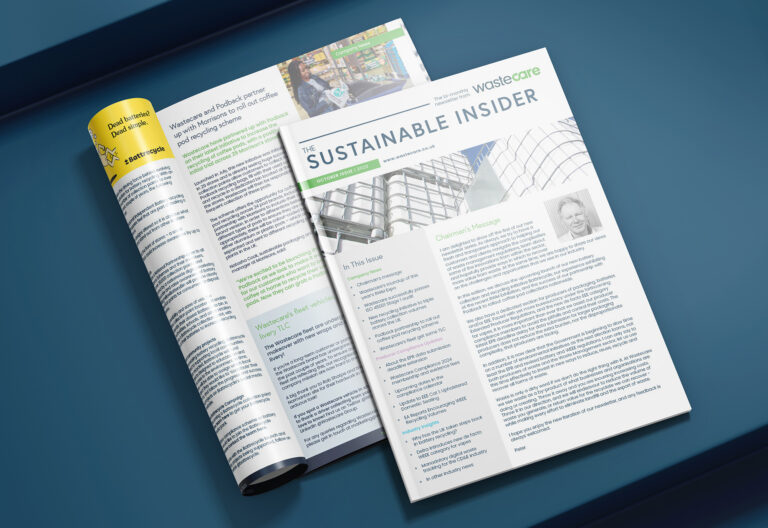
Wastecare are extremely proud to re-introduce our newsletter series – The Sustainable Insider. This bi-monthly newsletter will provide insights into the world of hazardous waste management and recycling, from the wider sector as a whole down to the perspectives of Wastecare themselves.
As always, we try to have a fresh and transparent approach to helping our customers and clients navigate the complexities of waste management regulations, learn about some of the innovations from within the sector, and hopefully provide ways in which to recover more value from waste. At the same time, we share our views on the challenges and opportunities that we see in our industry.
In our October 2023 edition, we discuss:
- The upcoming launch of our new battery collection and recycling initiative Battrecycle
- Our experience exhibiting at the recent RWM Exhibition
- The success of our partnership with Podback to rollout coffee pod collections nationwide
- The EPR data delays for packaging producers
- Defra’s introduction of a new de facto EEE category for vapes
- Investigate how influencing public behaviour could reduce battery fires
We will also have a dedicated producer compliance section, to ensure our WEE, battery, and packaging scheme members are kept up to date with the latest regulations surrounding their obligations and data submission deadlines. With upcoming webinars hosted by our Producer Compliance team, and guidance on navigating the complexities of the EPR deadline delayed until May 2024, we will endeavour to use this newsletter to alleviate the extra burden producers are currently facing.
This renewed newsletter will also see an introduction from our Chairman Peter Hunt, who will undoubtedly provide an honest and upfront reflection on the waste sector as we navigate reducing companies’ waste and recovering value.
We hope you enjoy October’s issue of The Sustainable Insider.
Alternatively, download our newsletter here.
For media enquiries, please contact marketing@wastecare.co.uk.
Get in Touch
Contact our friendly team of experts to arrange a collection or just enquire about our services.
Call us today on 0800 091 0000
or email us on recycling@wastecare.co.uk
Defra has implemented a de facto EEE Category 15 for vapes via a Producer Compliance Scheme Balancing System, to ensure collection and recycling costs are covered by vape manufacturers and importers.
Disposable vapes have quickly become one of the most talked-about topics in the UK, with the waste, environmental, and public sectors raising countless concerns about the product’s rapid rise in uptake and its impact on public health and the environment.
As a result, councils nationwide have been publicly applying pressure on Defra and the EA to either fast-track the implementation of stricter policies to manage responsible vape disposal and recycling or impose a ban on disposable vapes altogether.
This call for specific WEEE regulations on vapes has now led to a de facto 15th EEE category for vapes through the PBS backstop provision (Producer Compliance Scheme Balancing System), to ensure that the cost of collection and treatment is borne by the manufacturers and those that import vapes into the UK.

Significant cost implications
As we warned the industry earlier in the year, their failure to implement a holistic national recycling solution for vapes, adopted by their customers, could now see their costs of compliance increase by 500% over the next 3 months with little to no control.
The Environment Agency began the first step of implementing the changes by writing to producer compliance schemes on the 27th of September. They are now required to disclose the weight of vapes placed on the market by their members so that the cost of collection and treatment at local authority household waste recycling centres can be charged back.
We are expecting a significant initial cost for vape producers. Due to the cost of vape treatment, there is likely to be a large backlog at local authority sites that have been waiting for this change to recycle their vapes at no cost.
With estimates placing grey market and illegal vapes at 45% of those sold and discarded, this will likely result in a disproportionately high cost for responsible vape producers who, having fulfilled their legal obligations by joining a WEEE compliance scheme, now find themselves having to fund the recycling of all vapes, including the contraband. Further to this, the rules do not distinguish between reusable and disposable vapes, so despite producers of reusable vapes being overwhelmingly the most compliant under the WEEE regulations and producing the least waste, they are being dealt a double blow for the cost of recycling.
Managing the impact
With the rumoured ban on disposable vapes unlikely to be implemented before 2025 (if at all), if the vape industry is to bring down the cost of WEEE producer compliance, they must act in unison to take control of the recycling situation. Although we have helped organisations from NHS Trusts and Universities, through to retailers like VPZ and Tesco to implement a vape recycling solution for their customers (we are in fact, close to hitting 5,000 drop-off points across the UK), there is still much to do. A national, coordinated education and collection campaign, driven by the industry would allow them not only greater control over their costs but to encourage responsible recycling, reducing the 700 fires caused by vapes in recycling facilities every year and safeguarding the lithium contained in their devices.
If you’re a vape producer wishing to discuss your obligation with our compliance team, please contact us at compliance@wastecare.co.uk
For more information on our vape and battery collection services, please contact the team at recycling@wastecare.co.uk, or call 0800 091 0000.
Get in Touch
Contact our friendly team of experts to arrange a collection or just enquire about our services.
Call us today on 0800 091 0000
or email us on recycling@wastecare.co.uk

In recent years, we have all been witness to a concerning increase in UK battery fires, posing significant risks to public safety and the environment. These fires are often ignited during the disposal and recycling of batteries, which contain hazardous materials like lithium-ion.
This increase has now accelerated sharply, with local authorities across the UK now reporting battery-related fires at their recycling centres and waste facilities on an almost monthly basis. These fires not only endanger workers but also release toxic fumes into the atmosphere contributing to hazardous air pollution. Additionally, the financial burden of extinguishing these fires and addressing their aftermath falls on local communities and taxpayers.
Can we pinpoint the UK battery fire issue?
As a provider of recycling solutions, this dramatic increase in battery fires combined with increased media coverage has become a pressing discussion within Wastecare. We know recycling accessibility is not a barrier, with us as a company alone providing over 30,000 battery collection points nationwide. In addition, the ability to manage increased recycling would also not pose an issue, with our battery processing facility in Halifax offering a capacity capable of recycling 100% of the UK’s used portable batteries. Therefore, we know that it’s not because the means to recycle batteries aren’t there - the British public simply doesn’t feel incentivised to carry it out.
With millions of portable batteries on the UK market, analysing the attitudes towards batteries themselves may expose the root of the problem. Batteries are an easy commodity to come by in your local supermarket or electronics retailer, with a range of price points making them accessible to a majority. In regards to the disposal of these, statistics show that the average person in the UK will throw away 10 portable batteries a year. Our assumption, therefore, is that if one individual is throwing less than one portable battery away a month it may not feel like a pressing issue to recycle them – due to the infrequent habit of having to do it. However, the cumulative impact of this action on a yearly basis equates to over 600 million batteries.
What’s more, the knock-on effect of low recycling volumes continues to impact the battery producers themselves. With revised battery regulations expected in 2024/25, if the current levels of recycling are maintained the UK is unlikely to meet its battery recycling targets – significantly impacting obligations costs for compliant producers.
So how can we influence public behaviour?
Motivating a habit change – Consumer-facing businesses manufacturing or distributing portable batteries have a responsibility to provide incentives to recycle them. Point-of-sale call-to-actions are often relied upon to remind consumers to recycle, however, the ability to provide further education via digital platforms should not be overlooked. Campaigns such as Material Focus’ ‘Hypnocat’, are brilliant examples of using positive and engaging social media messaging to emphasise the dangers of not recycling WEEE. With large platforms with a high reach across the UK, major retailers have a responsibility to use these social platforms to provide education on recycling initiatives and support their consumers on how and where they can access collection points.
Looking within the workplace – Although digital campaigns have a place and can have significant reach, the power of education drives within the workplace shouldn’t be underestimated. With companies and offices nationwide containing hundreds of thousands of portable battery consumers – implementing internal communications on recycling along with convenient collection solutions within local areas can be a valuable addition to aiding consumer consciousness. This can have a two-fold impact – managing the usage of WEEE products using portable batteries in the workplace, whilst encouraging employees to utilise collection points to recycle their own household batteries.
Local authorities reporting fires – The unfortunate inevitability is that battery-related fires are unlikely to slow down until recycling rates rise significantly. By reporting fires occurring in local authorities’ recycling facilities and waste centres, this key trend data is key to getting public attention on how serious the problem has become.
Conclusion
Ultimately, all those who play a role in the life cycle of portable batteries have a responsibility to educate and support the wider UK population on battery recycling. This will require a cohesive and joint-up approach, as we know one consistent message is far more effective than a confusing narrative of conflicting instructions.
From our standpoint, it is about emphasising the impact of battery fires in a way that resonates with the majority of consumers whilst aiding convenient and easy collection – resulting in a culture change making battery recycling as habitual as putting out your household waste black bin. Imminent pan-industry schemes are set to be implemented, however, large retailers serving much of the UK population also have a responsibility to harness the platforms they have to influence battery consumer habits.
Get in Touch
Contact our friendly team of experts to arrange a collection or just enquire about our services.
Call us today on 0800 091 0000
or email us on recycling@wastecare.co.uk


