The Fridge Crisis Nobody Is Talking About
England’s fridge recycling network is under serious strain. Here is what is happening, why it matters, and what you should know right now.
There is a quiet crisis developing in the UK’s waste infrastructure, and it involves something most of us take entirely for granted: the humble fridge. It isn’t the first time the UK has faced something like this either — the “fridge mountain” of the late 1990s is still referenced as a cautionary tale in the industry.
Right now, the network of specialist treatment plants responsible for processing end-of-life fridges and freezers in England is under significant and growing pressure. Plant closures and a recent fire at a treatment facility have removed meaningful capacity from the system at a stroke, and the consequences are already being felt across the industry. The Environmental Services Association, the trade body representing the UK’s major waste operators, canvassed its members at the Environment Agency’s request just days ago, and the picture that emerges is consistent and concerning. Across every company that responded, the message is the same: capacity is tightening, the system is under strain, and without intervention, things could get considerably worse before they get better.
This is not a minor operational inconvenience. It is a structural problem, and it is worth understanding why.
Why fridges are different from other waste
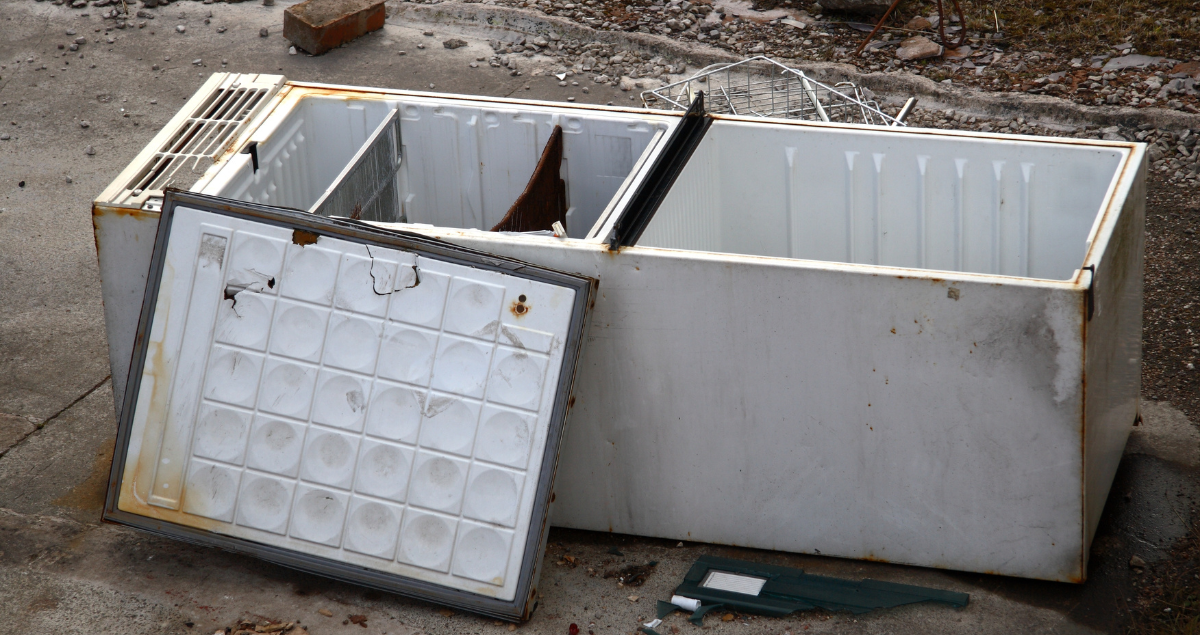
Fridges and freezers are not straightforward to recycle. They contain a mix of hazardous materials that require specialist handling, most notably the refrigerant gases and the foam insulation blown with CFCs and HCFCs. These are potent greenhouse gases, some many thousands of times more damaging than carbon dioxide, and their safe recovery and destruction is tightly regulated as part of our wider hazardous waste collection and recovery service. You cannot simply crush a fridge and sort the metal. It has to go to a licensed WEEE treatment facility equipped specifically for the job, where the gases are extracted and the different material streams separated and processed safely — with the recovered refrigerant gases ultimately sent for high-temperature incineration to ensure safe, permanent destruction.
That specialist requirement is precisely what makes the current capacity shortage so difficult to resolve quickly. You cannot open a new fridge treatment facility overnight. The permitting process alone takes time, the equipment is specialised, and the expertise required is not widely available. When capacity disappears from the system, it does not come back fast.
What the ESA feedback tells us
The feedback gathered by the ESA from major operators paints a clear picture. Capacity constraints are national, not local, though certain regions are feeling the pressure most acutely already. The Midlands, particularly Birmingham and Shropshire, and the South East and South of England are identified as early flashpoints. Collection delays are being reported. The number of available tipping and disposal sites is shrinking. Operators are holding stock for longer, meaning fridges are sitting at collection sites and waste transfer stations while treatment routes are secured.
The situation is described by one operator as evolving daily, which is another way of saying that no one can be entirely certain where capacity will be available from one week to the next. It’s a similar dynamic to the one we wrote about when the Environment Agency last raised WEEE recycling targets — tightening obligations meeting a system with limited room to absorb them.
There is also a seasonal dimension that adds urgency. Summer is peak season for refrigeration failures. Households and businesses replace more fridges in the warmer months, and that predictable surge in volumes is arriving into a system that is already stretched.
The containers that qualify need to carry the Exchange for Change logo, which is the official brand identity for the UK scheme, announced in January 2026. Producers must register their products with Exchange for Change before the October 2027 launch.

Two very different groups affected, in two very different ways
It is worth being precise about who is affected and how, because the fridge recycling system has two distinct parts that operate quite separately from one another.
The first is the household stream. When a member of the public drops off an old fridge at their local household waste recycling centre, or has it collected by a retailer when a new one is delivered, the cost of recycling it is not borne by the council, the retailer or the individual. It is funded indirectly by producers of cooling equipment, such as manufacturers and importers, who are members of producer compliance schemes. Under WEEE regulations, retailers have a legal obligation to offer takeback of old appliances when delivering new ones, and the recycling of those collected units is funded through the same producer compliance mechanism. Compliance schemes like Wastecare’s WEEECare manage those obligations on behalf of producers, contracting with collectors and treatment plants to ensure the recycling actually happens.
When treatment capacity tightens, this group faces a particular kind of pressure. The physical recycling becomes harder to arrange and more expensive to procure, which puts strain on compliance schemes trying to meet their members’ obligations. Where a scheme cannot meet its full recycling target, a fallback mechanism called the compliance fee exists, allowing schemes to pay into a fund for every tonne short of their obligation. It is a legitimate safety valve, but it is not the preferred outcome for anyone. Actual recycling is always the goal.
Retailers have a legal obligation to take back your old fridge when delivering a new one. The cost of recycling it is funded indirectly by producers through compliance schemes.
The second group is businesses with industrial fridges and freezers to dispose of. Commercial cold storage units, industrial refrigeration plant, and catering and food production equipment: none of this falls within the producer compliance mechanism. There is no scheme funding the recycling of these units. Businesses simply have to pay the market rate for disposal, and right now, the market rate is rising through our bulk electronic waste recycling route, or as part of a wider industrial container recycling programme where cooling units are being decommissioned alongside other equipment, with associated industrial packaging recycled or reconditioned at the same time. Gate prices at the treatment plants that still have available capacity have already increased significantly. Where options are limited, prices go up, and that is a direct and immediate cost for any business needing to move industrial cooling equipment.
The compliance risk that nobody should overlook
There is a third dimension to this story that is easy to miss but carries real regulatory risk. Permitted sites, whether that is a waste transfer station, a household waste recycling centre or a commercial premises holding waste, operate under environmental permits that set limits on how much waste can be stored on site at any one time.
When treatment capacity dries up and fridges cannot move downstream as quickly as normal, those storage limits can be breached through no fault of the operator. Fridges are bulky and space-intensive, meaning even a short delay in securing a treatment route can tip a site over its permitted storage allowance surprisingly quickly. This kind of pressure is exactly what creates the conditions for the illegal side of the market too — we’ve previously reported on compressors being illegally stripped from fly-tipped fridges, a problem that tends to worsen whenever legitimate disposal routes become harder or more expensive to access.
Operators who are managing this situation responsibly, doing everything they can to find treatment capacity while holding stock temporarily, should not face regulatory action for circumstances entirely outside their control.
Wastecare’s position
We want to be straightforward about our position here. Wastecare is a national collector and we have the operational flexibility to move fridges to wherever treatment capacity exists across the country, drawing on our full range of collection and bulk recovery services. That is an advantage not every operator has, and we are using it actively to protect our customers from the worst of the disruption. But that flexibility has limits. Treatment capacity in England is finite, and when it contracts at a national level, no amount of operational agility fully insulates you from it.
The gate price increases we are already seeing are real, and we expect further volatility as summer demand builds. We are being transparent with our customers about this, and we would encourage anyone with large volumes of end-of-life industrial cooling equipment to speak to us sooner rather than later. The earlier we can plan, the better the outcome for everyone.
For our WEEECare producer compliance customers, we want to be clear that we are working hard to fulfil recycling obligations through whatever treatment capacity we can access. We will always prioritise actual recycling over the compliance fee fallback, both because it is better for the environment and because it is what our members are counting on us to deliver. Fridge recycling pricing is likely to be volatile this year however, and we will keep members informed as the picture develops.
On the regulatory dimension, we think the Environment Agency’s approach here matters enormously. The EA exists to support sustainable and safe waste management, and we would urge a pragmatic and supportive stance toward legitimate, permitted operators who are temporarily holding more stock than their permit allows, simply because treatment capacity has collapsed through no fault of their own. Penalising operators for doing the right thing, while the industry works to restore capacity, would be unnecessarily punitive and would serve nobody’s interests, least of all the environment’s. We would encourage any operator in this position to engage with the EA proactively, document the steps they are taking to resolve the situation, and make clear they are managing the issue responsibly.
The broader lesson here is one the industry has encountered before. When specialist treatment infrastructure is lost, it is not easily or quickly replaced. The UK’s capacity for handling complex and hazardous waste streams needs sustained investment and protection as a matter of ongoing industrial policy, not just crisis management when things go wrong. A problem like this one is a reminder of how much the entire recycling system depends on infrastructure that most people never think about until it stops being available.